 Skip to content
The wrong engine oil is just as dangerous to your vehicle as a worn-out belt. It’s a frustrating reality for many UK drivers, especially when a Wet Belt Replacement is the only thing standing between you and a £3,000 engine failure. You’re likely feeling the weight of conflicting service intervals and the fear that a generic garage might miss the subtle signs of trouble. It’s stressful to manage a vehicle when the stakes for your wallet and your daily commute are this high.
This guide will show you exactly how to protect your engine and avoid catastrophic damage with expert, up-to-date advice. We’ll walk you through the latest 2026 requirements for popular Ford and PureTech engines, the science behind belt degradation, and how to secure the long-term health of your vehicle. By the end, you’ll have a clear plan to ensure your personal car or commercial fleet remains safe, efficient, and reliable on the road.
Key Takeaways
- Learn why the “Belt-in-Oil” design requires specific maintenance to prevent rubber debris from blocking your engine’s oil galleries.
- Discover how to identify early warning signs, such as ticking noises or loss of power, before they escalate into a total engine failure.
- Understand the critical importance of using manufacturer-approved oil during a Wet Belt Replacement to prevent the belt from flaking and degrading.
- Gain a clear overview of the professional diagnostic process, including the essential step of inspecting the engine sump for contamination.
- Find out how proactive, specialist servicing can protect your personal vehicle or commercial fleet from unexpected downtime and high-cost repairs.
What is a Wet Belt Replacement and Why is it Critical?
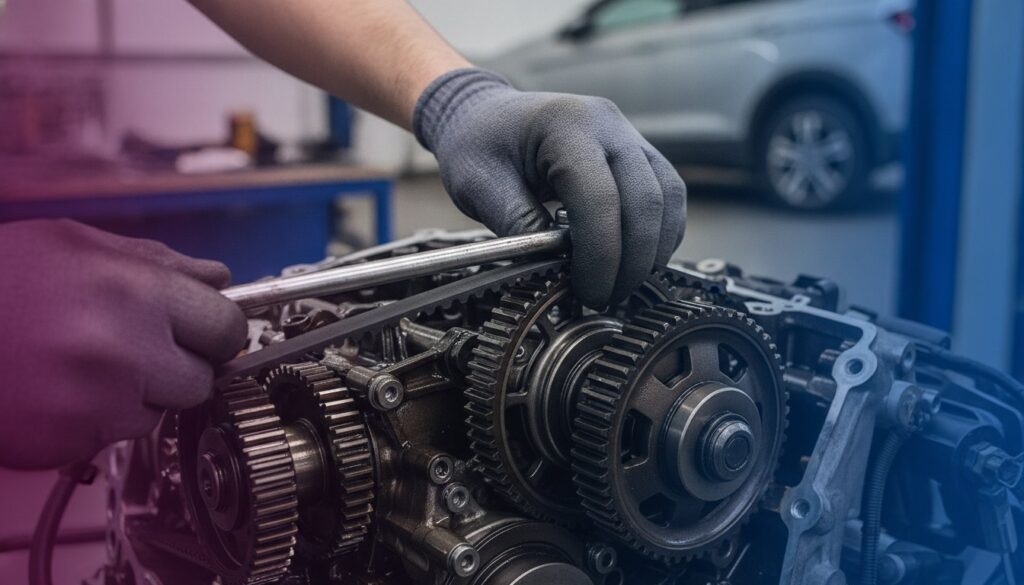
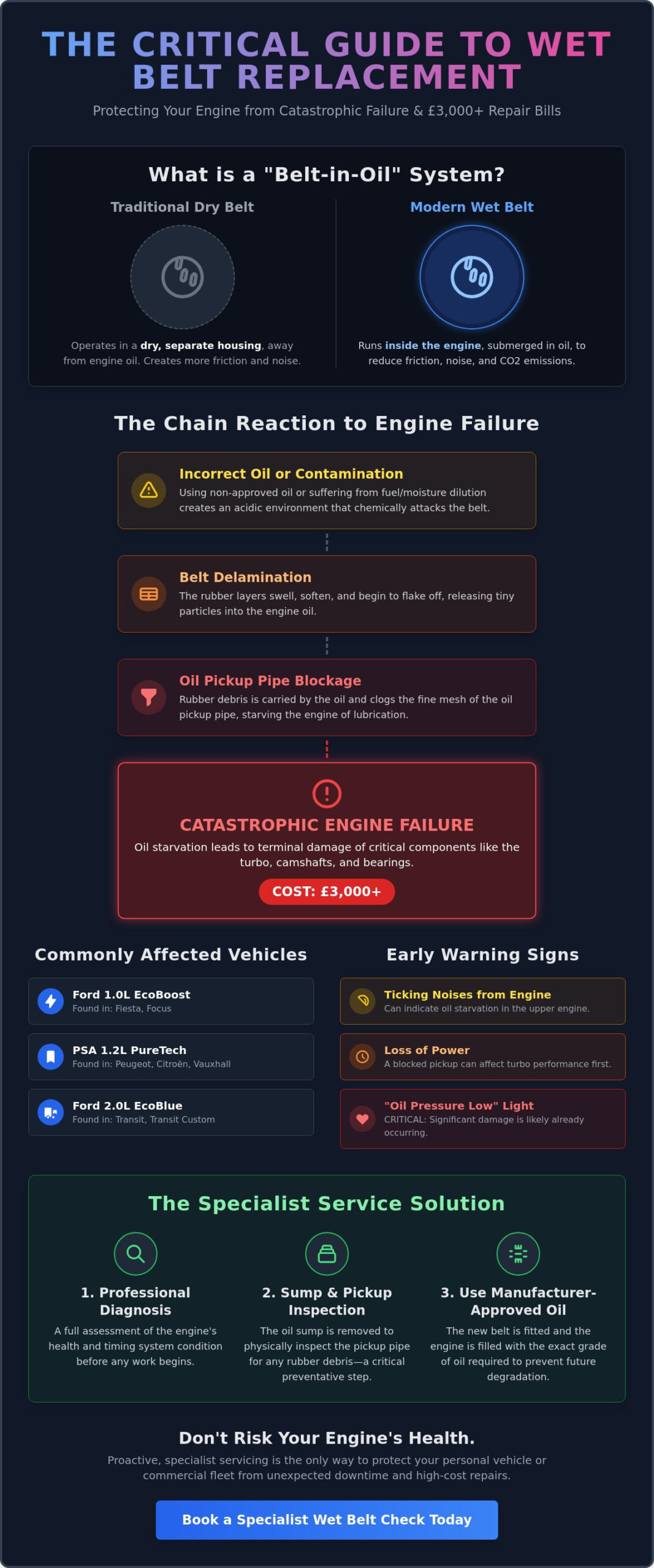
A Wet Belt Replacement is more than just standard maintenance; it’s a surgical procedure for your engine’s timing system. Traditional cambelts are kept dry and separate from the engine’s internal lubrication. In contrast, a “Belt-in-Oil” (BIO) system places the belt directly inside the engine casing. It runs through the same oil that lubricates your pistons. This design was a radical shift in automotive engineering, intended to combine the quiet operation of a belt with the longevity of a chain. However, as many UK drivers have discovered, this system requires a very specific approach to maintenance to avoid disaster.
The primary goal of this technology was efficiency. By submerging the belt in oil, manufacturers reduced mechanical drag and friction. This allowed modern, downsized engines to meet strict UK and European CO2 targets whilst significantly quietening the engine’s operation. It sounds like a win-win on paper, but it creates a unique vulnerability. If the oil becomes contaminated or the wrong grade is used, the belt begins to break down. This makes a Wet Belt Replacement a preventative necessity rather than an optional upgrade. Waiting for a symptom often means you’re already facing a terminal engine failure.
The Evolution of Timing Belts: Why Wet Belts Exist
Manufacturers moved towards wet belt systems to keep up with tighter emissions standards. A dry belt creates friction as it moves over pulleys. By moving this system into an oil bath, engineers achieved a smoother rotation. This small gain in efficiency helped manufacturers squeeze better fuel economy out of smaller, turbocharged engines. Whilst the theory was sound for efficiency, it placed a massive burden on the quality of the engine oil. Ford and the PSA Group (Peugeot, Citroen, and Vauxhall) were the primary pioneers of this technology amongst their fleets, aiming for a balance between performance and environmental impact.
Identifying if Your Vehicle Uses a Wet Belt System
Knowing if your vehicle uses this design is the first step in avoiding a massive repair bill. This technology is found in several of the UK’s most popular cars and vans. Common examples include:
- Ford 1.0L EcoBoost: Found in the Fiesta and Focus. Many owners have faced Ford EcoBoost wet belt issues due to missed service intervals or incorrect oil usage.
- PSA 1.2L PureTech: Widely used in the Peugeot 208, Citroen C3, and modern Vauxhall models.
- Ford 2.0L EcoBlue: The workhorse engine for the Ford Transit and Transit Custom fleets across West Lothian.
If you aren’t sure about your engine type, don’t leave it to chance. You can check your vehicle handbook or contact a specialist in Livingston for verification. A quick professional check is far cheaper than a full engine rebuild.
The Science of Failure: How Oil Degrades Your Timing Belt
The environment inside a modern combustion engine is a hostile place. Whilst a traditional cambelt operates in a dry, external housing, a wet belt is constantly submerged in a hot chemical bath of engine oil. This design relies on a precise chemical balance. If that balance is disrupted, the belt material begins to lose its structural integrity. It isn’t a sudden snap that usually causes the problem; it’s a slow, microscopic decay known as delamination.
Delamination occurs when the outer layers of the rubber belt begin to swell, soften, and eventually flake off. These tiny fragments of rubber don’t just disappear. They’re carried by the oil flow throughout the engine, eventually settling in the lowest point: the oil sump. This process is often accelerated by “stop-start” driving. Short journeys in Livingston or surrounding West Lothian towns prevent the oil from reaching its optimum temperature. This leads to fuel dilution and moisture build-up in the lubricant, creating an acidic environment that chemically dissolves the belt material over time.
The Danger of the Oil Pickup Pipe Blockage
A blocked pickup pipe is the primary cause of catastrophic engine failure in vehicles using this technology. Think of the pickup pipe as a straw that the engine uses to draw oil from the sump to lubricate the turbo, camshafts, and bearings. This “straw” has a very fine mesh screen designed to catch small contaminants. When a belt delaminates, the rubber debris quickly mats across this mesh. Delamination is the primary precursor to oil starvation in BIO systems. Once the flow is restricted, the engine’s vital components grind against each other without protection.
If you see the “Oil Pressure Low” warning light flicker on your dashboard, it’s a sign that significant damage is already occurring. At this stage, the engine is gasping for lubrication. Many drivers mistake this for a simple sensor fault, but in a wet belt engine, it’s often the final warning before the internal components seize entirely. Proactive professional vehicle servicing is the only way to catch this debris before it chokes your engine.
Why Oil Choice is Non-Negotiable for Wet Belts
You cannot use generic lubricants in these engines. Wet belt systems require specialised chemical additives that are specifically engineered to protect the rubber whilst it remains submerged. Generic “supermarket” oils often lack these specific manufacturer approvals. Using the wrong grade can lead to rapid belt swelling and premature failure, sometimes years before the official service interval.
At Jedox Fleet, we ensure only manufacturer-approved lubricants are used during every service. We understand that the longevity of your Wet Belt Replacement depends entirely on the quality of the oil it lives in. By sticking to these rigid standards, we provide the peace of mind that your engine is protected against the chemical degradation that claims so many unmaintained units.
Warning Signs and Replacement Costs for UK Drivers
Detecting the early stages of belt decay requires a keen ear and a proactive mindset. Unlike a traditional dry belt that might snap without warning, a wet belt often leaves a trail of breadcrumbs before the engine fails entirely. You may notice a subtle ticking noise from the front of the engine or a rough idle that feels uncharacteristic for your vehicle. These are often the first indicators that fragments are beginning to circulate in the oil. If your vehicle enters “limp mode” or displays a check engine light, it’s frequently triggered by fault codes like P0011 or P0014. These codes point to timing synchronisation issues, suggesting the belt has already begun to stretch or slip.
The cost of a Wet Belt Replacement is largely driven by the intensive labour required to do the job correctly. It isn’t a simple “off and on” procedure. A professional service in 2026 involves deep cleaning the internal components to ensure no residual debris remains. When you compare the investment of preventative maintenance against the £3,000+ bill for a full engine rebuild, the financial benefit is obvious. Jedox Fleet provides transparent, itemised quotes for drivers across West Lothian and Edinburgh, ensuring you understand every stage of the process without hidden surprises.
Symptoms You Should Never Ignore
Listen for a distinct rattling sound coming from the lower part of the engine, which often indicates rubber debris is clumping in the sump. If the oil pressure warning light flickers, even for a second, you must stop the vehicle immediately. This flickering is a sign that the oil pickup pipe is nearly choked. In modern vans, degraded belt particles can trigger “limp mode” as a fail-safe to prevent the camshafts from seizing due to a lack of lubrication.
Understanding the Labour-Intensive Nature of the Job
A professional Wet Belt Replacement requires removing the engine sump for a manual inspection. This is a non-negotiable step; simply changing the belt without clearing the sump leaves your engine at risk of immediate oil starvation. The process also requires specialised timing tools to lock the crankshaft and camshaft in a precise position. In many Ford EcoBlue and EcoBoost engines, we also recommend replacing the smaller oil pump belt simultaneously. This ensures the entire internal drive system is refreshed, providing total peace of mind for your next 80,000 miles.
Professional Wet Belt Replacement: A Step-by-Step Guide
A professional Wet Belt Replacement is a methodical, multi-stage process that requires surgical precision. It isn’t a job that can be rushed or performed with standard hand tools found in a typical DIY kit. Because the belt lives inside the engine, every stage of the teardown and reassembly must be handled with extreme care to prevent contamination. Our technicians follow a rigid sequence to ensure your engine returns to factory-standard performance.
The process follows five critical stages:
- Step 1: Diagnostic Verification. We begin with a full diagnostic check to verify the current timing alignment and check for any stored fault codes related to camshaft synchronisation.
- Step 2: Sump Removal. After draining the oil, we remove the engine sump. This is the only way to truly assess the level of belt degradation and debris accumulation.
- Step 3: Strainer Cleaning. We manually clean the oil pickup strainer. This mesh is often clogged with rubber “shavings” that must be completely removed to restore oil flow.
- Step 4: Precision Installation. The old belt is removed and the new unit is installed. We use manufacturer-specific locking tools to ensure the crankshaft and camshaft are perfectly aligned.
- Step 5: Final Reassembly. The engine is sealed with new gaskets and refilled with the exact manufacturer-approved oil grade required for your specific engine code.
The Importance of Sump Cleaning
Simply changing the belt is only half the job. If a garage replaces the belt but leaves the sump untouched, your engine remains at risk. Residual rubber fragments will stay trapped in the oil galleries, eventually migrating back to the pickup pipe and causing oil starvation. We perform an intensive “flush” of the oil galleries to ensure no microscopic debris remains. This level of thoroughness is what differentiates a specialist Wet Belt Replacement from a “budget” fix that might leave you stranded just a few months later.
Quality Parts and Specialist Tooling
We only use OE-equivalent belts from trusted manufacturers like Dayco or Gates. These components are engineered to withstand the chemical stresses of being submerged in oil for years. Using generic belts is a false economy that often leads to premature failure. Furthermore, timing accuracy within 0.5 degrees is essential for engine efficiency and preventing long-term valve damage. “Universal” timing kits simply cannot provide this level of accuracy on complex EcoBoost or PureTech engines, which is why we invest in the exact specialist tooling required for every model we service. If you’re concerned about your vehicle’s health, you can book your wet belt inspection with our Livingston team today.
Specialist Wet Belt Services in Livingston and West Lothian
Choosing a local specialist for your Wet Belt Replacement is the most effective way to safeguard your vehicle’s future. At Jedox Fleet, we’ve established ourselves as the go-to centre for Ford, Peugeot, and Citroen owners across West Lothian. Our Livingston facility is perfectly situated for drivers in Edinburgh, Bathgate, and Falkirk who require more than just a standard oil change. We understand that trust is built on transparency. That’s why we make a point of showing you the condition of your old belt and the debris cleared from your sump. Seeing the physical evidence of wear helps you understand exactly why this preventative work was essential for your engine’s survival.
We don’t just follow a checklist; we apply deep technical knowledge to every vehicle that enters our workshop. Our team is trained to spot the subtle indicators of belt swelling that generic garages often overlook. By catching these issues early, we help you avoid the stress and massive financial burden of a total engine failure. Whether you’re a private motorist or managing a large organisation, our goal is to provide a service that is as thorough as it is reliable.
Supporting Local Business Fleets
For fleet managers, a single engine failure is more than a repair bill; it’s a logistical nightmare that leads to significant downtime and lost revenue. We specialise in supporting delivery and service fleets that rely on Ford Transit and PSA-group vans to stay operational. Our scheduled maintenance programmes are designed to include proactive wet belt monitoring, ensuring that your vehicles are serviced before they reach the “danger zone” of belt degradation. We have the capacity to handle both Class 4 and Class 7 commercial vehicles, making us a versatile partner for businesses of all sizes across the region. Keeping your fleet on the road requires a methodical approach to engine health, and we’re here to provide that stability.
Why Choose Jedox Fleet for Your Engine Repair?
Our expertise extends far beyond simple parts replacement. We possess advanced diagnostic capabilities and extensive engine rebuild experience, allowing us to handle even the most complex mechanical challenges. We take a “right first time” approach to every job, ensuring that timing is set with absolute precision and only manufacturer-approved lubricants are used. This commitment to quality ensures that your vehicle leaves our centre in peak condition, ready for the miles ahead. Don’t wait for a warning light to tell you there’s a problem. Book your Wet Belt Replacement at our Livingston centre today and ensure your engine remains in safe, expert hands.
Secure Your Engine’s Future Today
If you own a Ford EcoBoost or PSA PureTech vehicle, staying ahead of belt degradation is the most important maintenance decision you’ll make this year. A proactive Wet Belt Replacement isn’t just about following a service schedule; it’s about protecting your investment from catastrophic oil starvation. By ensuring the engine sump is cleared and manufacturer-approved oil is used, you effectively eliminate the debris that leads to terminal engine failure. Taking action now prevents the stress of a breakdown and the significant cost of a full engine rebuild later.
Our team in Livingston brings specialised expertise to every repair, using advanced engine diagnostic tools to verify your vehicle’s health with absolute precision. We serve drivers and fleet managers across Edinburgh and West Lothian, providing the transparent, high-quality care that complex modern engines require. Don’t leave your engine’s survival to chance when expert help is just around the corner. Get a professional Wet Belt Replacement quote from Jedox Fleet today and enjoy the peace of mind that comes with expert vehicle care. We’re here to help you stay on the road safely and efficiently.
Frequently Asked Questions
How long does a wet belt replacement take?
A professional Wet Belt Replacement typically takes between 4 and 8 hours to complete. This timeframe is necessary because the procedure involves more than just swapping the belt; the technician must also drain the oil, remove the sump, and clean the oil pickup strainer. Complex engines like the Ford EcoBoost require precision timing alignment using specialist tools, which naturally adds to the labour time required for a thorough job.
Can I drive my car if the wet belt is overdue for replacement?
Driving with an overdue wet belt is extremely risky and can lead to sudden, terminal engine failure. Unlike traditional belts, a wet belt degrades internally through delamination, meaning you won’t see the damage from the outside. Once the rubber fragments block the oil pickup pipe, your engine will suffer from oil starvation within seconds, potentially leading to a repair bill exceeding £3,000.
Which Ford engines have a wet belt?
The most common Ford engines featuring this design are the 1.0L EcoBoost and the 2.0L EcoBlue units. These are found in popular UK models like the Fiesta, Focus, and the Transit Custom van range. Whilst the 1.0L EcoBoost has an official interval of 8 years or 80,000 miles, many specialists recommend earlier replacement due to higher failure rates observed in real-world driving conditions across the UK.
How much does a wet belt replacement cost in the UK?
Independent garages in the UK typically charge between £800 and £1,200 for this service. Main dealer prices are often significantly higher and can frequently exceed £1,500 depending on the specific model and your location. It’s vital to ensure your quote includes a full sump inspection and cleaning, as skipping this essential step can lead to immediate engine issues even after a new belt is fitted.
Is a wet belt the same as a cambelt?
A wet belt is a specific type of cambelt that operates inside the engine’s oil system rather than in a dry housing. Traditional cambelts are “dry” and sit outside the main engine block behind a plastic cover. The “wet” design was intended to reduce friction and engine noise, but it requires much stricter adherence to oil specifications to prevent the rubber from chemically breaking down over time.
What happens if my wet belt snaps whilst driving?
If the belt snaps whilst you’re driving, the synchronisation between the pistons and valves is lost instantly. This causes the valves to strike the pistons at high speed, resulting in catastrophic internal damage. In most cases, a snapped belt requires a complete engine rebuild or a replacement engine, which is far more expensive than investing in a preventative Wet Belt Replacement.
Does my Peugeot PureTech engine have a wet belt?
Yes, the 1.2L Peugeot PureTech engine is one of the most well-known units to use a “belt-in-oil” system. This engine is also widely used in Citroen, DS, and modern Vauxhall models. As of late 2025, the recommended replacement interval for these engines is 6 years or 62,000 miles, though regular oil inspections are strongly advised to check for early signs of belt swelling or flaking.
Can I use 5W-30 oil in a wet belt engine?
You should only use 5W-30 oil if it meets the exact manufacturer specification for your specific engine code. Whilst some PureTech engines were updated to a specific 5W-30 (specification FPW9.55535/03) in late 2025, others, like the Ford EcoBoost, still require a 5W-20 (WSS-M2C948-B). Using an oil with the wrong chemical composition will cause the belt to swell and degrade prematurely, leading to a blocked oil system.