 Skip to content

Did you know that approximately 28% of vehicles in the UK fail their initial MOT test on the very first attempt? For many drivers, this annual requirement feels like a gamble that often results in unexpected repair bills and the stress of being without a car for several days. It’s easy to feel overwhelmed by technical jargon from garages, especially when a simple oversight leads to a “Major” failure. Understanding the most common mot failures is the first step toward regaining control over your vehicle’s maintenance and avoiding unnecessary costs.
We believe that passing your test shouldn’t be a matter of luck. In this guide, you’ll learn how to perform a 10-minute home inspection to catch issues before you even reach the testing centre. We’ll break down the most frequent reasons for failure in 2026, from lighting defects to tyre tread depth, and explain which minor niggles are actually critical safety risks. Our goal is to help you secure that first-time pass certificate with total confidence, ensuring your vehicle remains safe, legal, and ready for the road.
Key Takeaways
- Understand the 2026 defect categories-Minor, Major, and Dangerous-and how each one affects your vehicle’s legal status.
- Identify the most common mot failures, such as faulty bulbs and suspension wear, which contribute to the nearly 30% failure rate.
- Learn how to perform a simple 10-minute home inspection using basic items to catch obvious faults before your appointment.
- Master the legal requirements for tyre tread depth and windscreen condition to avoid easily preventable test rejections.
- Discover why a professional pre-MOT check is a cost-effective way for fleet managers and private owners to ensure a first-time pass.
Understanding the MOT Test: Why Do Nearly 30% of Vehicles Fail?
The annual MOT test is often viewed with a sense of dread by many drivers, but its primary purpose is simple: safety. It’s a mandatory inspection designed to ensure that every vehicle on UK roads meets the minimum legal standards for environmental impact and roadworthiness. However, statistics show that nearly 28% of vehicles fail their initial test. This high failure rate often stems from a misunderstanding of what the test actually covers. Whilst many owners assume their car is in good health because it starts reliably, the inspection focuses on components that are frequently neglected until they stop working entirely.
Failure rates vary significantly between vehicle types. For Class 4 vehicles, which include most passenger cars, the pass rate is generally higher than for Class 7 commercial vans. Light commercial vehicles often endure harder lives, covering more miles on rougher terrain, which leads to accelerated wear on suspension and braking systems. By staying aware of common mot failures, you can transition from reactive repairs to proactive maintenance, which is almost always the more cost-effective choice. Fixing a small issue during a routine check is significantly cheaper than dealing with a failed certificate and the subsequent rush to book repairs.
The Difference Between an MOT and a Full Service
It’s a common misconception that a pass certificate means your vehicle is in perfect mechanical condition. An MOT is a visual inspection; the tester won’t take your engine apart or check the health of your gearbox. They’re looking at safety critical items like seatbelts, lights, and tyres. For a comprehensive health check that ensures long-term reliability, you need Professional Vehicle Servicing in West Lothian. A service looks at the “internal” health of the car, such as oil quality and engine components, which the MOT tester simply isn’t required to examine.
Major vs Dangerous Defects: Can You Still Drive?
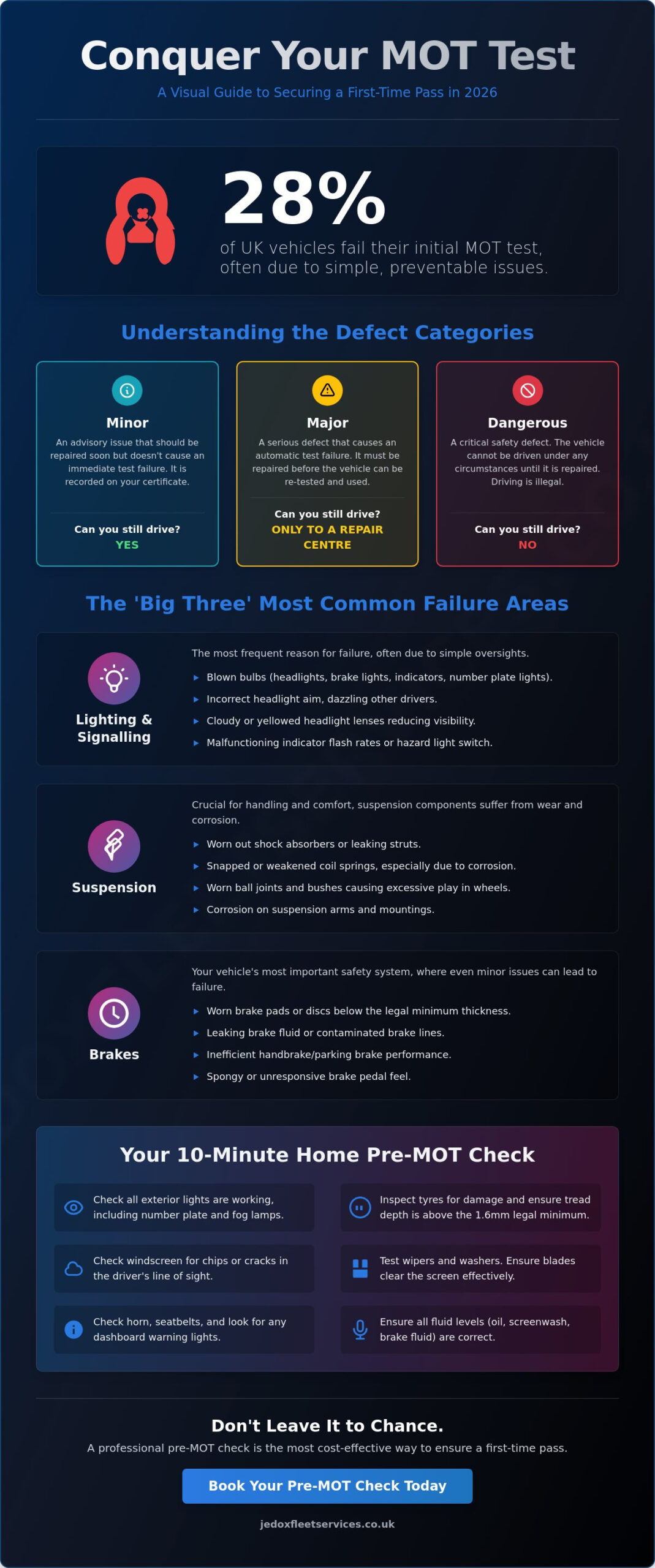
Since the grading system update, defects are categorised into three distinct levels. Understanding these is vital for your legal safety. A ‘Minor’ defect is essentially a formal warning; you pass the test, but the issue must be repaired soon. A ‘Major’ defect results in an automatic fail. You’re legally allowed to drive the vehicle to a repair centre, provided your previous MOT is still valid, though this is not recommended. A ‘Dangerous’ defect is the most serious. It carries an immediate road ban. You cannot drive the vehicle away from the testing station under any circumstances, as doing so poses a direct risk to yourself and other road users. Identifying common mot failures before the test can prevent the nightmare of being stranded at a garage with a ‘Dangerous’ fail notice.
The ‘Big Three’ Common MOT Failures: Lights, Suspension, and Brakes
Whilst thousands of components are checked during an inspection, the vast majority of common mot failures fall into three specific categories: lighting, suspension, and brakes. These systems are the most exposed to the elements and mechanical stress, yet they are often the most neglected by owners. Neglecting these areas doesn’t just risk a fail certificate; it significantly compromises your safety on the road. By identifying these issues early, you can avoid the inconvenience of a retest and the associated repair costs.
Lighting and Signalling: More Than Just Bulbs
A blown bulb is perhaps the most frustrating reason to fail because it is so easily preventable. However, the test goes deeper than just checking if the lights turn on. Testers examine the flash rate of indicators and the operation of the hazard light switch. Fog lamps and number plate lights are frequently overlooked by drivers during their own checks. According to the RAC’s analysis of common MOT fails and how to avoid them, headlight aim is another frequent culprit. Over time, the plastic lenses on modern headlights can become cloudy or yellowed, which scatters the beam and results in a failure due to poor visibility.
Suspension and Steering in the UK Climate
Drivers in West Lothian and Edinburgh face unique challenges due to the local climate and road conditions. The frequent use of road salt during Scottish winters is essential for grip, but it is incredibly corrosive to underbody components. We often see snapped coil springs and heavily corroded suspension arms amongst vehicles that haven’t been regularly cleaned underneath. Potholes are another major factor; hitting a deep one can instantly damage a shock absorber or knock your steering out of line. If you notice your car pulling to one side or hear a knocking sound over bumps, it is often a wise move to check your 4-wheel alignment before your MOT date arrives.
Brake Performance and Safety
The braking system is tested on a rolling road to measure efficiency and balance. A car that pulls to one side under braking will fail, as this indicates an imbalance across the axle. Testers also look for physical signs of wear, such as thin pads or pitted discs. Spongy pedals are a red flag for air in the hydraulic system or a fluid leak. Corrosion is a particular issue here too; brake pipes made of steel can rust through if exposed to salt and moisture for too long. Checking your handbrake travel is also vital. If you have to pull the lever to its absolute limit to hold the car, it likely needs adjustment or new shoes. These common mot failures are often progressive, meaning they get worse over time, so early detection is key to keeping repair bills manageable.
Visibility, Tyres, and Emissions: The Overlooked Essentials
While mechanical issues like suspension and brakes often dominate the list of common mot failures, smaller details regarding visibility, tyre health, and emissions are just as likely to cause a fail. These “overlooked essentials” are frequently the easiest to check at home, yet they account for thousands of failed certificates every month. In modern vehicles, these systems are increasingly integrated with complex electronics, meaning a simple physical fault can often trigger a wider system failure that prevents your car from being legally roadworthy.
Tyre Safety and Legal Requirements
Your tyres are the only point of contact between your vehicle and the road, making them a primary focus for any tester. The legal minimum tread depth is 1.6mm across the central three-quarters of the tyre, but safety experts often recommend replacing them at 3mm. Testers don’t just look at tread depth; they also inspect the sidewalls for bulges, cuts, or perishing. For vehicles registered after January 2012, a functioning Tyre Pressure Monitoring System (TPMS) is mandatory. If your dashboard displays a TPMS warning light, it’s an automatic failure. We frequently see budget tyres that, whilst legal in depth, have perished prematurely due to poor rubber quality, leading to a fail on structural integrity.
Windscreens and Obstructions
Visibility is strictly regulated through the ‘Zone A’ rule. This is the 290mm wide section of the windscreen centred on the steering wheel. In this critical area, any chip or crack larger than 10mm will result in a failure. Elsewhere on the swept area of the screen, damage can be up to 40mm. Some of the most avoidable common mot failures are “silly” mistakes, such as an empty screenwash bottle or worn wiper blades that smear the glass. Even interior items like large air fresheners or poorly positioned dash cams can be classed as obstructions to the driver’s view. It’s best to clear your dashboard and rearview mirror entirely before heading to the testing centre.
Emissions and Diesel Particulate Filters (DPF)
Environmental standards have become significantly stricter. For diesel owners, the Diesel Particulate Filter (DPF) must be present and untampered with; any evidence of a DPF removal or a smoky exhaust will lead to an immediate fail. The Engine Management Light (EML) is another critical factor. If this light stays illuminated during the test, the vehicle cannot pass, as the tester cannot verify that the emissions systems are functioning correctly. To ensure a clean reading, particularly for diesel cars used mainly for short trips, it’s beneficial to take the vehicle for a longer motorway drive prior to the test to allow the exhaust system to reach its optimum operating temperature.
Modern vehicles in 2026 also rely heavily on Advanced Driver Assistance Systems (ADAS). These include lane-keep assist and autonomous braking cameras, often mounted behind the windscreen. If your windscreen has been replaced or your suspension altered without professional recalibration, these systems may malfunction. Testers are now more vigilant regarding ADAS warning lights, as a failure in these sensors can compromise the vehicle’s safety technology. Ensuring these cameras are clear and calibrated is now just as important as checking your tyre pressure.
How to Perform a 10-Minute Pre-MOT Check at Home
Many drivers assume they need advanced mechanical knowledge to prepare for a test, but the reality is quite different. You can spot the majority of common mot failures by simply using your eyes, a 20p coin, and the help of a friend. This 10-minute ritual often saves you the time and expense of a retest. It puts you in the driver’s seat when it comes to your vehicle’s maintenance, ensuring you don’t get caught out by avoidable issues.
Inside the Cabin: Safety and Controls
Start by sitting in the driver’s seat to check the internal safety components. Test every seatbelt in the car, including the rear ones. Pull them out fully to inspect for frays or cuts, then give them a sharp tug to ensure the locking mechanism engages properly. They must also retract smoothly back into the housing. Next, press the horn; it needs to be loud and clear to pass. Finally, turn on the ignition and watch the dashboard. All warning lights should illuminate and then go out. If an ABS, airbag, or engine management light stays on, it’s an immediate failure. Also, ensure the driver’s seat moves forward and backwards and locks securely in position.
The Walk-Around: Exterior Integrity
Step outside and walk around the vehicle to check its physical condition. Enlist a helper to stand at the rear whilst you cycle through the indicators, brake lights, and fog lamps. This ensures every bulb is functioning correctly without you having to jump in and out of the car. Inspect your mirrors to ensure they are secure and the glass isn’t cracked. Check your number plates; they must be clean, free from cracks, and use the standard legal font. Illegal spacing or decorative fonts are frequent reasons for common mot failures. Don’t forget the fuel cap. Open the flap and check that the seal inside the cap isn’t perished and that the cap clicks or locks into place. For the tyres, take your 20p coin and insert it into the tread grooves. If you can see the outer rim of the coin, your tread is likely below the legal 1.6mm limit.
Fluid Levels and Functionality
Open the bonnet to check your essentials. Empty screenwash is one of the most avoidable reasons for a fail, so top it up to the brim. Whilst you’re there, check your brake fluid and oil levels. Although low oil isn’t a direct MOT fail, the tester may refuse to run the emissions test if the level is too low to be safe. You should also sit in the car and press the brake pedal; it should feel firm and offer resistance rather than feeling spongy or sinking to the floor. If you’re unsure about any of these checks or want a professional eye to look over your vehicle, our team can provide a comprehensive Pre-MOT Check and Repair to guarantee peace of mind.
Professional Pre-MOT Solutions in Livingston and West Lothian
Whilst a home inspection is an excellent starting point, many common mot failures are hidden deep within the vehicle’s mechanical or electronic systems. For fleet managers in West Lothian, a failed test is more than just a nuisance; it’s a loss of revenue and operational continuity. Investing in a professional pre-test inspection ensures that your vehicles are not just meeting the minimum legal requirement but are genuinely safe for the heavy-duty cycles they perform. Our team takes a methodical approach, using the same criteria as an official tester to identify potential pitfalls before they lead to a fail certificate.
Modern vehicle technology requires more than just a visual check. If your dashboard is showing an Engine Management Light (EML), the vehicle cannot pass its emissions test. We use advanced automobile diagnostic services to identify the root cause of these faults, ensuring they are cleared and repaired correctly. Additionally, our mobile tyre fitting service is designed for maximum convenience. If your home check reveals that your tread is low or the sidewalls are perished, we can replace them at your location. This solves one of the most frequent reasons for common mot failures without you having to visit a garage twice, saving both time and fuel.
Specialist Support for Vans and Motorhomes
Large commercial vehicles fall under Class 7 MOT regulations, which involve stricter checks on braking efficiency and load-bearing components. We specialise in preparing these larger vans for their annual test, acknowledging that they often suffer more from underbody corrosion due to the grit and salt on Scottish roads. Motorhome owners also benefit from our specialist motorhome MOT preparation. We understand that these vehicles often sit idle for long periods, which can lead to seized brakes or perished tyres. Our team organises all necessary repairs to ensure your holiday plans remain uninterrupted by a surprise failure at the testing centre.
Why Choose Jedox Fleet for Your MOT Needs?
Based in Livingston, we provide expert support across Edinburgh, Bathgate, and the surrounding areas. Our reputation is built on transparency; we provide honest advice on advisories so you can plan your maintenance budget without surprises. We don’t just find faults; we offer the solutions. From simple brake repairs to complex engine rebuilds, our workshop is equipped to handle every aspect of vehicle health. We believe in building long-term partnerships with our clients through quality workmanship and a commitment to keeping your wheels turning safely throughout the year.
Book your pre-MOT check and repair with Jedox Fleet today to ensure your vehicle passes its test first time and stays on the road where it belongs.
Secure Your First-Time MOT Pass with Confidence
Navigating the annual test doesn’t have to be a source of anxiety. Most common mot failures are entirely preventable through basic home checks and a proactive approach to maintenance. By identifying issues with lighting, visibility, and tyres before you reach the testing centre, you significantly reduce the risk of a fail certificate and the stress of unexpected repairs. Remember that the MOT is a safety baseline; staying ahead of minor wear and tear is the most cost-effective way to manage your vehicle’s health.
For drivers in Livingston and across West Lothian, professional preparation offers the ultimate safety net. Whether you require expert Class 4 and 7 MOT preparation, advanced diagnostics to clear engine management lights, or convenient mobile tyre fitting, our team provides the reliable support you need. We focus on transparency and quality workmanship so you can drive away with a pass certificate and total peace of mind.
Book Your Professional Pre-MOT Inspection at Jedox Fleet today. We look forward to helping you keep your vehicle safe, legal, and road-ready for the year ahead.
Frequently Asked Questions
What are the most common reasons for a car failing its MOT?
The most frequent culprits include faulty light bulbs, worn suspension components, and poor brake performance. Statistics show that nearly 30% of initial tests result in a fail, often due to simple issues like blown number plate lights or empty screenwash bottles. Understanding these common mot failures allows you to perform basic checks at home and avoid the inconvenience of a retest.
Can I drive my car if it fails its MOT test?
You can only drive the vehicle if your current MOT certificate is still valid and no “Dangerous” defects were identified. If the tester finds a “Dangerous” fault, you’re legally prohibited from driving the car until it’s repaired. For “Major” failures where the old certificate hasn’t expired, you may drive to a repair centre, but it’s always safer to have the work completed immediately.
How long does an MOT test usually take?
A standard MOT test typically takes between 45 and 60 minutes to complete. You should allow extra time for the technician to process the paperwork and walk you through any advisories or failure points. Many garages recommend dropping your vehicle off for a few hours to ensure the inspection fits smoothly into their daily schedule.
Is a cracked windscreen an automatic MOT failure?
A cracked windscreen only results in a failure if the damage exceeds specific size limits within defined zones. In “Zone A”, which is the 290mm wide area centred on the steering wheel, any chip or crack larger than 10mm causes a fail. In other parts of the windscreen’s swept area, the damage can be up to 40mm before it triggers a failure.
Do dashboard warning lights cause an MOT fail?
Yes, several critical dashboard warning lights will result in an automatic failure if they stay illuminated during the test. This includes lights for the ABS, airbags, Tyre Pressure Monitoring System, and Electronic Stability Control. The Engine Management Light is also a major failure point, as it prevents the tester from verifying that the emissions systems are functioning correctly.
How much tread depth do tyres need to pass the MOT?
The legal minimum tread depth for tyres is 1.6mm across the central three-quarters of the tread and around the entire circumference. Whilst this is the absolute limit for the test, we advise replacing tyres when they reach 3mm to ensure optimum grip in wet weather. Testers also check for sidewall bulges, cuts, or perishing, which are common mot failures amongst older vehicles.
Can I take my MOT test early and keep the old expiry date?
You can have your MOT test carried out up to a month, minus one day, before your current certificate expires whilst still preserving the original renewal date. This “30-day rule” is a great way to stay organised and allows time for repairs if any issues are found. If you test the vehicle earlier than this window, the new expiry date will be set for exactly one year from the date of the new test.
What happens if I miss my MOT deadline?
Driving without a valid MOT is illegal and can result in a fine of up to £1,000 and the invalidation of your insurance policy. The only legal exception is if you’re driving the vehicle directly to a pre-booked MOT appointment. You can’t park the vehicle on a public road without a valid certificate, so it’s vital to stay on top of your renewal dates.