 Skip to content

What if the £54.85 you spend on an MOT is actually the least important investment you make in your car this year? Most drivers in West Lothian feel a twinge of anxiety when the time for Vehicle Servicing approaches, fearing the aggressive upselling tactics often found at national chains or the hidden costs that can derail a monthly budget. It’s a common concern, especially with the average car on UK roads now reaching a record age of ten years. You deserve a maintenance partner that prioritises transparency over a quick profit.
We understand that you want a reliable vehicle that won’t let you down on the M8, backed by a stamped logbook that protects your resale value. This guide will help you master the essentials of maintenance, showing you why fleet-standard precision is the secret to total reliability on Scottish roads. You’ll discover the clear differences between interim and full service requirements, whilst learning how to navigate 2026 regulations like the emerging Euro 7 standards. We provide the clarity you need to ensure you only pay for exactly what your vehicle needs to stay safe, efficient, and roadworthy.
Key Takeaways
- Understand why an MOT only confirms legal safety whilst professional Vehicle Servicing acts as preventative medicine to ensure long-term mechanical health.
- Learn how to choose between interim, full, and major service levels based on your annual mileage and the specific technical requirements of modern engines.
- Discover how proactive maintenance, such as timely oil changes and wet belt replacements, prevents catastrophic engine failure and protects your fuel economy.
- Master simple pre-service checks, from fluid levels to locating your locking wheel nut, to ensure a smooth inspection and reduce vehicle downtime.
- Explore the benefits of a “fleet-first” approach that treats every private car or van with the same rigorous precision used for mission-critical business vehicles.
The Importance of Professional Vehicle Servicing in 2026
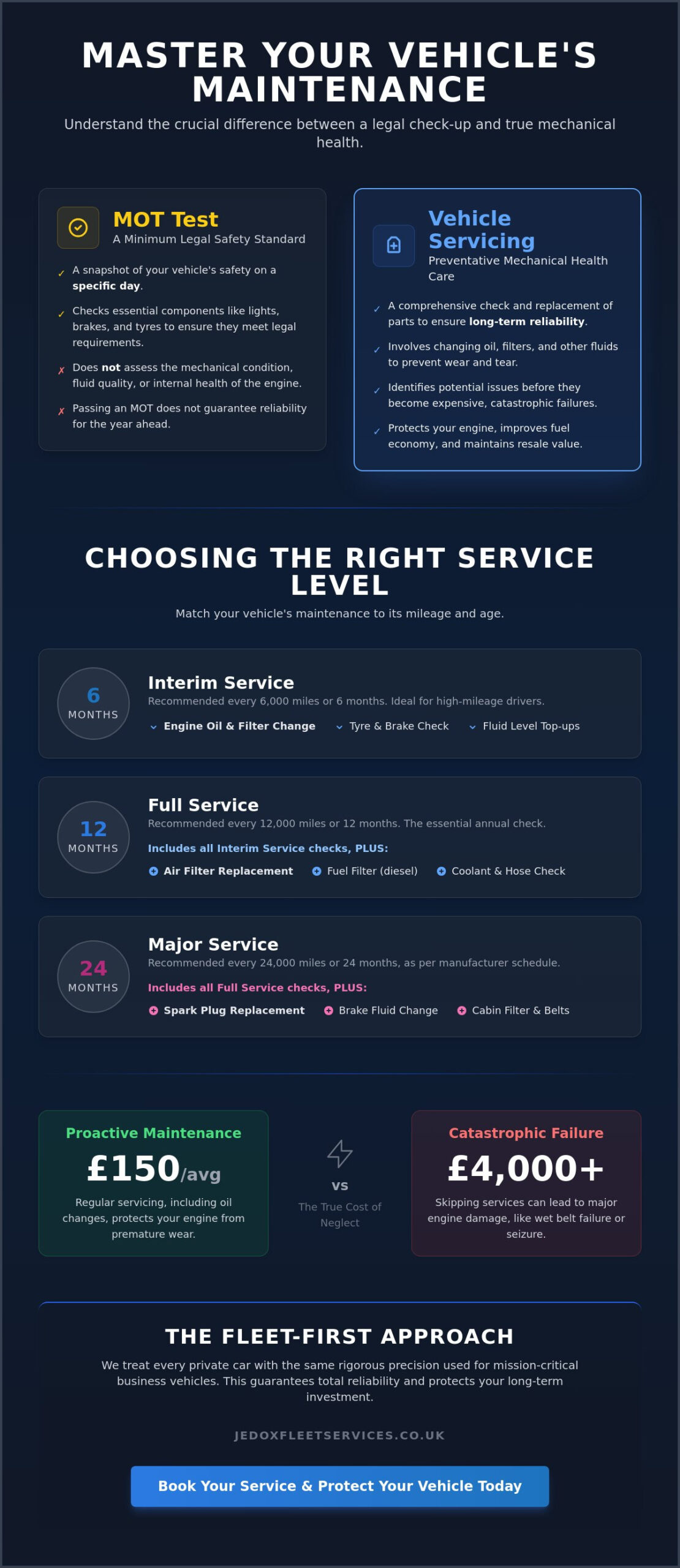
Think of your car as a complex organism. If an MOT is a basic fitness test required by law, then professional Vehicle Servicing is the preventative medicine that keeps the heart of your machine beating. Many drivers in West Lothian mistakenly believe that passing an MOT means their car is in perfect health. The MOT is simply a snapshot of safety at a single moment in time; it doesn’t check the quality of your oil, the condition of your filters, or the internal wear of your engine components. Ignoring these factors is often what leads to unexpected and expensive repair bills later in the year.
A comprehensive motor vehicle service involves a deep dive into the mechanical integrity of your transport. This distinction is vital in 2026, as the average age of UK vehicles has climbed to nearly ten years. Older cars require more than just a legal pass. They need active maintenance to combat the specific environmental challenges of Central Scotland. The heavy use of road salt on the M8 and local Livingston roads during winter creates a corrosive environment. This salt can silently eat away at your vehicle’s underside and brake lines if it isn’t monitored through regular, professional inspections that go beyond the scope of a standard MOT.
Safety and Reliability on West Lothian Roads
Driving in West Lothian presents unique challenges for any vehicle. The prevalence of deep potholes on rural routes and busy urban stretches in Bathgate or Falkirk puts immense strain on your suspension components and wheel alignment. A professional service identifies these issues before they lead to a snapped spring or dangerously uneven tyre wear. Reliability is non-negotiable for the daily Edinburgh commute. By catching a thinning brake pad or a degrading battery early, you avoid the stress and danger of a roadside breakdown during peak traffic or whilst on a long family journey.
Protecting Your Long-Term Investment
Maintaining a full service history isn’t just about paperwork. It’s a strategic move to protect your bank balance. A vehicle with a consistently stamped logbook can command thousands of pounds more at resale compared to one with gaps in its history. Regular oil changes are the simplest way to ensure engine longevity, preventing the buildup of carbon and sludge that leads to catastrophic failure. Staying on top of your service schedule also ensures your manufacturer warranty remains valid, protecting you from the high costs of major mechanical faults. This methodical approach transforms your vehicle from a depreciating liability into a well-managed asset that remains efficient and safe for years.
Choosing the Right Level: Interim vs Full vs Major Service
Deciding which level of Vehicle Servicing your car requires is a matter of logic rather than guesswork. Most modern vehicles follow a schedule based on either time or mileage, but the standard “once a year” rule doesn’t always apply if you’re frequently traversing the M8 or M9. You need to align your maintenance with your specific driving habits to avoid unnecessary wear. Choosing the wrong level can lead to missed components or, conversely, paying for work that isn’t yet necessary. We believe in a transparent approach that matches the service to the actual needs of your vehicle.
The Interim Service: For High-Mileage Drivers
Drivers who cover more than 8,000 miles annually usually benefit from an Interim service every 6,000 miles or six months. This level focuses on high-wear items that degrade quickly under heavy use. It includes an oil and filter change, which is critical for modern engines that rely on clean lubrication to protect sensitive turbochargers. For West Lothian commuters, this check provides peace of mind regarding tyre tread depth and brake pad thickness before the seasons change. Adhering to these Vehicle maintenance, safety and security standards ensures your car remains reliable between its larger annual appointments. It’s a proactive way to catch minor issues, like a small nail in a tyre or a weeping shock absorber, before they leave you stranded.
Full and Major Services: The Deep Dive
A Full service is typically an annual event or every 12,000 miles. It goes significantly deeper than an Interim check, replacing air filters and inspecting the radiator, coolant hoses, and auxiliary belts. By 2026, many vehicles on our roads are approaching a decade in age, making these comprehensive inspections essential for long-term health. We also check the pollen filter to ensure the air inside your cabin remains clean, which is particularly important if you spend significant time in heavy traffic around Livingston or Edinburgh.
A Major service is the ultimate “reset” for your vehicle, usually required every 24 months or 24,000 miles. This includes replacing long-life components such as spark plugs or fuel filters. Unlike a basic top-up, these services often involve full system flushes for brake fluid or gearbox oil to remove contaminants that cause internal damage. If you’re unsure which schedule your car is currently on, our team can help you book the correct level of vehicle servicing based on your car’s age and recent history. This methodical approach ensures every component, from the smallest sensor to the gearbox, receives the attention it deserves.
The True Cost of Neglect: Avoiding Expensive Repairs
Neglect doesn’t always announce itself with a cloud of smoke or a loud bang. Often, the true cost of skipping your Vehicle Servicing is found in the subtle, daily drain on your finances. Modern engines are precision instruments; even a slight deviation in oil viscosity or a partially clogged filter can force the system to work harder, burning more fuel to achieve the same performance. Over a year of commuting, these inefficiencies add up to a sum that far outweighs the cost of a routine check. Professional maintenance ensures every penny you spend at the pump is converted into motion rather than wasted heat and emissions.
The financial risk of neglect extends to your braking system. Identifying thin brake pads during a routine inspection allows for a simple, cost-effective replacement. If you wait until you hear a metal-on-metal grinding noise, the pads have likely already scored and damaged the expensive discs. By then, a minor maintenance task has escalated into a much larger bill for a full axle set. This pattern of small faults turning into major failures is exactly what we aim to prevent through methodical, fleet-standard inspections. For businesses managing multiple vehicles, a structured approach to fleet management services UK operators rely on can transform these unpredictable costs into a manageable, preventative maintenance schedule.
Efficiency and Environmental Impact
A clean air filter ensures the engine receives the correct volume of oxygen for optimal combustion, preventing unburnt fuel from exiting the exhaust. This efficiency is the key to passing the increasingly strict MOT smoke and emissions tests required for 2026. Beyond the engine, we also look at the connection between tyre alignment and fuel consumption. Misaligned wheels drag against the road surface, increasing rolling resistance and forcing the engine to work harder. Regular Vehicle Servicing includes checking these parameters to ensure your car operates at its peak environmental and financial performance.
Specialist Maintenance: DPF and Wet Belts
Diesel Particulate Filters (DPF) are a common pain point for drivers in West Lothian. If you primarily use your car for short trips around Livingston shopping centres or school runs, the exhaust may never reach the temperature required for passive regeneration. Without professional monitoring to trigger a cleaning cycle, you risk a total blockage. Replacing a DPF can cost well over £1,000, a figure that is easily avoided through regular diagnostic checks and proper maintenance.
We also pay close attention to the “Wet Belt” systems found in many modern Ford and PSA engines. These timing belts run inside the engine oil to reduce friction. If the oil becomes contaminated or old, the belt material begins to degrade, shedding debris that can clog the oil pump and lead to total engine failure. Advanced diagnostics allow us to catch sensor faults or early signs of belt wear before they trigger a “Limp Mode” event. By adhering to strict replacement intervals, you protect the heart of your vehicle from catastrophic damage that could otherwise end its life on the road prematurely.
Preparing for Your Service and MOT in Livingston
Preparing for your appointment is the best way to ensure a smooth, efficient experience. Whilst our technicians handle the heavy lifting, a few simple steps on your part can prevent delays and help us focus on the technical health of your car. Vehicle Servicing is most effective when the technician has clear access to all areas of the vehicle, from the engine bay to the boot floor. Taking ten minutes to organise your car before arriving can make a significant difference in the speed of the inspection.
One of the most common hurdles we encounter is the missing locking wheel nut key. If we can’t remove your wheels, we cannot perform a thorough brake repair inspection or carry out dynamic wheel balancing. Please ensure this key is left in a visible place, such as the centre console or the passenger seat. Similarly, clearing out personal clutter allows our team to check seatbelt pretensioners and floor mounting points without hindrance, which is a mandatory part of the MOT process.
The Pre-Service Checklist for Owners
Before you drop off your keys, take a moment to check your own fluid levels and tyre pressures. Whilst we will address these during the service, knowing your baseline helps us identify if your car is consuming oil or coolant at an unusual rate. You should also:
- Locate your service book or ensure you have access to your digital service records.
- Note down any specific sounds, such as a rhythmic clicking or a high-pitched squeak, to help our mechanics with their automobile diagnostic service.
- Ensure there is at least a quarter tank of fuel, as diagnostic testing and emissions checks require the engine to run at operating temperature.
Combining MOT Preparation with Servicing
Combining your annual MOT with a professional service is the most cost-effective strategy for any driver. This approach allows us to identify and rectify common failure points, such as blown bulbs or worn wiper blades, before the official test begins. Whether you require a Class 4 MOT for a standard car or a Class 7 MOT for a heavy commercial van, a pre-test service significantly reduces the chance of a “Refusal to Issue a Certificate.”
This dual approach is especially beneficial for motorhomes and large delivery vans that face rigorous safety standards. By addressing mechanical health and legal safety simultaneously, you minimise your vehicle’s downtime and ensure it remains a reliable asset on the road. If your anniversary date is approaching, you can schedule your vehicle servicing and MOT together to stay fully compliant with the least amount of hassle.
Jedox Fleet: Bringing Fleet-Standard Care to Every Driver
At Jedox Fleet, we apply a “mission-critical” mindset to every car that enters our Livingston centre. Fleet operators depend on their vehicles for their livelihood, which means maintenance must be precise, documented, and proactive. We bring this same level of rigour to private Vehicle Servicing. Whether you’re a local resident or a business owner, your vehicle receives the same systematic attention to detail that keeps commercial fleets moving across the UK. We don’t believe in cutting corners because we understand that for you, your car isn’t just a machine; it’s your connection to work, family, and the road.
Our technicians have deep roots in West Lothian, understanding the specific wear patterns caused by the local terrain in Bathgate and the heavy traffic flows of Falkirk. This local expertise is backed by an automobile diagnostic service that goes far beyond simple code reading. We don’t just tell you what an electronic sensor says; we investigate the mechanical root cause. This methodical approach prevents the “parts-darts” game where components are replaced unnecessarily. By identifying the actual source of a fault, we save you time and ensure the repair is permanent rather than a temporary fix.
Specialist Services Across West Lothian
Our Livingston facility is equipped for more than just routine oil changes. We offer precision 4-wheel alignment to counteract the inevitable pothole damage from rural lanes and complex engine rebuilds for those seeking to extend the life of an older vehicle. For busy Edinburgh professionals, our mobile tyre fitting service provides the ultimate convenience, bringing fleet-standard efficiency directly to your home or workplace. We also support local businesses with structured fleet maintenance and repair, ensuring their vans and cars remain safe and compliant without disrupting their daily operations.
Our Commitment to Transparency
Honest communication is the cornerstone of our relationship with every driver. We provide a clear, itemised breakdown of all work carried out during your service, explaining our findings in plain English without the confusing jargon. We always prioritise safety-critical repairs, such as brake repair or suspension work, over cosmetic issues. This ensures your budget is spent where it matters most: keeping your vehicle roadworthy and efficient. By maintaining this level of transparency, we help you build a reliable service history that protects your vehicle’s resale value and your peace of mind. You can book your professional vehicle service with Jedox Fleet today to experience a higher standard of local care.
Securing Your Vehicle’s Future on Central Scotland’s Roads
Maintaining a car in 2026 requires more than just a legal MOT pass; it demands a proactive approach to mechanical health. By choosing the correct level of maintenance and preparing your vehicle for inspection, you avoid the common pitfalls of DPF blockages and catastrophic engine failures. Professional Vehicle Servicing is the most effective way to protect your resale value whilst ensuring your daily commute remains safe and efficient. Our team combines local expertise across West Lothian and Edinburgh with the technical precision of advanced engine diagnostics.
Whether you drive a private car or manage a commercial van, our Class 4 and 7 MOT specialists are here to provide the fleet-standard care your vehicle deserves. We focus on transparent communication and safety-critical repairs to keep you moving without the stress of hidden costs. It’s time to take control of your car’s longevity with a partner you can trust. Book your vehicle service at our Livingston centre today and enjoy the peace of mind that comes from expert, honest maintenance.
Frequently Asked Questions
How often should you service your car in the UK?
Most manufacturers recommend a service every 12,000 miles or every 12 months, whichever arrives first. If you’re a high-mileage driver or frequently use your vehicle for short city trips in Livingston, an interim check every 6,000 miles is often necessary. This ensures that high-wear components like oil and filters are replaced before they cause internal engine damage.
What is the difference between an MOT and a vehicle service?
An MOT is a mandatory annual inspection required by law to ensure your car meets minimum safety and environmental standards. It doesn’t involve replacing parts or fluids. In contrast, professional Vehicle Servicing is a comprehensive mechanical health check designed to maintain the engine and replace worn components to prevent future breakdowns.
How much does a car service cost in 2026?
The cost of a service depends on your vehicle’s make, model, and the level of inspection required. Whilst the legal maximum fee for a Class 4 MOT is capped at £54.85, servicing costs vary based on the parts and oils your specific engine needs. Motorists in 2026 typically see the best value by combining their service with an MOT to reduce total workshop time.
Will skipping a service void my vehicle warranty?
Yes, failing to adhere to the manufacturer’s recommended maintenance schedule will almost certainly void your warranty. Most warranty providers require a documented history of Vehicle Servicing to honour claims for major mechanical faults. Keeping a stamped logbook or digital record is essential for protecting your investment and maintaining the car’s resale value.
How long does a full vehicle service usually take?
A full service typically takes between three and four hours to complete. This timeframe allows our technicians to conduct a thorough 50 to 70-point inspection, drain and replace the engine oil, and fit new air, fuel, and pollen filters. We also use this time to check the braking system and suspension components for signs of wear.
Can I service my own car to save money?
Whilst you can perform basic tasks like topping up screen wash, modern vehicles require specialist diagnostic equipment to reset service indicators and check electronic control units. Professional servicing ensures that complex systems like the DPF and wet belts are monitored correctly. Attempting a DIY service often leads to gaps in your service history, which reduces the vehicle’s market value.
What happens if my car fails its Pre-MOT check?
If we identify faults during a Pre-MOT check, we’ll provide you with a clear, itemised list of the necessary repairs. This allows you to address safety-critical issues before the official test begins. By fixing these problems early, you avoid a formal failure on your vehicle’s DVSA record and the hassle of arranging a retest.
Do electric vehicles (EVs) need regular servicing?
Electric vehicles still require regular maintenance even though they don’t need traditional oil changes. With BEVs now making up over 27% of the new car market, specialist checks for battery cooling systems, high-voltage cabling, and brake fluid condition are vital. EVs are often heavier than petrol cars, meaning suspension and tyre wear must be monitored closely to ensure safety.